About a year ago I found myself in a situation many people experience at some point in their career. I was between jobs and thinking about what skills would actually matter in the near future.
Whenever that happens, my instinct is always the same. I start learning.
Last summer I kept hearing more and more about Agentic AI. The idea that you could build AI agents to automate complex tasks sounded fascinating, so I decided to explore it seriously. I enrolled in the MindStudio bootcamp and spent several weeks learning how to build agents that could run different workflows.
The experience turned out to be extremely rewarding. I became one of the top students in the program, later helped mentor other participants, and eventually completed the certification.
But curiosity rarely stops with one platform. Whenever I learn a new technology, I always want to know what other tools exist that might solve similar problems in different ways. While exploring similar platforms, I discovered Lindy.
I signed up for Lindy Academy as well. In fact, I went through the program twice because I wanted to understand the platform more deeply. Building agents there was also fascinating, and I learned a lot through experimentation.
After several months of exploring these tools, I decided to organize a couple of webinars with a peer to share what I had learned. During those sessions we demonstrated several AI agents we had built and explained how they could be used in real business scenarios.
To my surprise more than 100 people registered, and about half attended live. That experience confirmed something important. Many professionals are curious about this technology but are still trying to understand how it fits into real work.
Enter Reality
Not long after those webinars I started a new marketing role. And like most marketing roles, it covered far more ground than the title suggested. From day one I was working across branding and content strategy all the way through to lead generation and sales enablement. A big part of my focus was converting leads into meetings, which meant I needed tools that could keep up with the pace.
My first instinct was to use the AI agent platforms I had just learned.
I tried using MindStudio and Lindy for lead generation workflows. Both tools are impressive and can automate certain tasks very well. However, after a few weeks I started noticing a pattern.
Building agents takes time. You have to design them carefully, test them, adjust prompts, and sometimes rebuild them when something changes. Many agents also end up being very specific. They work perfectly for one scenario, but if the conditions change even slightly you often have to redesign the workflow.
On top of that, the credit costs were adding up faster than the results. In a fast-moving environment where I needed to move quickly and iterate constantly, that combination became a real obstacle.
The Challenge of Collecting Conference Leads
One recurring task I had to handle was collecting lists of conference attendees for outreach. The goal was simple. Identify people attending certain industry conferences, enrich their company information, find valid email addresses, and send thoughtful outreach messages.
In theory AI agents should have been perfect for this. In practice it was more complicated.
Many conference websites protect their attendee lists. Some require login credentials. Others spread profiles across many pages. Some use lazy loading, where additional contacts appear only when you scroll.
When I tried automating this process with AI agent platforms I kept running into problems. I had to relaunch the agent on each page where attendees were listed across multiple pages. Contact details were sometimes mixed up or added to the wrong rows. In other cases the agent could not scrape the entire list because of lazy loading during scrolling. Meanwhile the platform credits were being consumed and I still did not have the list I needed.
Eventually I realized I was spending more time fighting the tool than solving the problem.
The Unexpected Solution: Python Scripts
At that point I tried a different approach.
Instead of building agents inside a platform, I started asking Gemini Pro to help me write small automation scripts that I could run directly on my computer.
With Gemini’s help I began creating simple Python scripts that ran locally on my Mac. I saved them on my computer and ran them whenever I needed them.
The idea was straightforward. The script would open a website, log in if necessary, navigate through the pages containing attendee profiles, scroll through the listings, and extract the relevant information. The data would then be saved directly into a CSV file that I could import into HubSpot.
What surprised me most was how well this worked.
You do not actually need to be a professional programmer to do this. A basic understanding of how web pages are structured is enough. If you can inspect a page and see where names, companies, and titles appear in the HTML structure, you can describe that to Gemini and it will generate the script.
Once the script is ready you simply run it on your computer and the data is collected in seconds.
This approach saved me an enormous amount of time. Instead of struggling with platforms and credit limits, I had a simple local tool that did exactly what I needed.
Why Clay Became Essential

Another tool that quickly became essential for me was Clay.
I first discovered Clay before starting my job when I joined one of their cohorts. At the time I was simply curious about the platform. Later I realized it was one of the most powerful tools for modern lead generation.
Clay connects to a large number of external data sources containing information about companies and professionals. This allows you to build very precise lists of potential customers.
If you know your ideal customer profile, you can describe it in detail. Maybe you want mid-size companies in a certain industry. Maybe you are targeting organizations within a specific revenue range. Or perhaps you want to reach people in roles such as heads of marketing or technology leaders.
Clay helps identify people who match those criteria and enrich their profiles with verified email addresses, company data, and other useful signals.
This is where outreach becomes far more effective.
Many people say email marketing no longer works. My experience has been different. Email stops working when it becomes irrelevant.
When the message reaches the wrong person or feels generic, people ignore it.
But when you send a thoughtful message to the right person at the right company and address a problem that actually matters to them, something interesting happens. People reply.
Exploring AI Music and Video

Outside of my work responsibilities, I also became fascinated with another side of AI: creative tools.
Recently I started experimenting with AI-generated music and video. If you spend time on social media, you have probably noticed how quickly this space is evolving. Many creators are now producing short films, animations, and music videos entirely with AI tools.
I wanted to explore it myself.
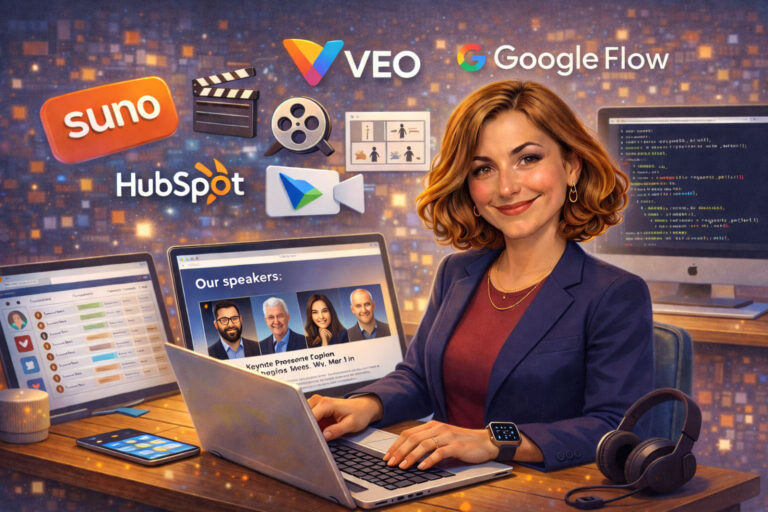
After experimenting with several platforms I found a combination that works well for me. I use Suno to generate music and tools like Google Flow, Veo, and Syntx AI to turn images and text prompts into videos. I also use lip-sync technology, which allows avatars to actually sing the songs.
Using these tools I started creating small music videos and experimenting with different storytelling styles.
And of course I could not resist including my dog Archie. He turns out to be an excellent character for AI videos.
For example:
- Archie starring in a stay-at-home dog musical performance
- Archie driving me to work and doing my job
- Archie and I dancing together
I also created an AI-generated music video about AI exploring our modern relationship with machines and how people sometimes turn to technology for reflection.
The project combines lyrics written by me, refined with ChatGPT, music generated in Suno, and visuals created from several Veo shots and dozens of Sora generations.
You can find more of my AI videos on my YouTube channel.
What began as a fun creative experiment quickly turned into an endless way to explore storytelling with AI.
My next step is to publish some of this music on Spotify, just for fun, and see where the journey leads.
The Game Changer I Wish I Had Found Sooner: Claude.AI and Claude Cowork
I will be honest. I was not expecting what happened when I started using Claude.ai and Claude Cowork.
I genuinely wish I had found these tools months ago. The hours I would have saved.
I have only been using them recently, but the impact was immediate. I now create all my documents directly in Claude. And here is something I did not expect: Claude is far better at writing blogs and LinkedIn posts than any other tool I have tried. You can actually train it to write in your specific style, and the output reads like a human writer, not like a chatbot generating filler.
But if I am being honest, my absolute favourites are the designed documents, HTML code, and Python scripts. The quality and speed there are on another level entirely.
I recently attended a Claude for Marketing webinar and it was genuinely eye-opening. I walked away realizing I can do so many more creative things with Claude than I had even imagined. The possibilities keep expanding the more I explore.
The thing that also blew me away was the research capability. I did a full competitor analysis covering over 50 competitors, pulling everything from their unique value propositions to their client profiles. I ran a SWOT analysis and then built my own magic quadrant. Think Gartner-level research, done by one person, without a team of analysts.
The secret? Claude paired with Clay. I call it my Clauday workflow (or Claide, I am still deciding), and if you want the recipe, reach out. I am happy to share it.
I am also planning to explore video editing with Claude soon, which I have a feeling is going to be another one of those moments where I wonder why i didn’t have this tool before.
If you are sleeping on Claude.ai and Claude Cowork, it might be time to take a closer look. For me, this one has been different.
Final Thoughts
Looking back, the past six months have been an incredible learning journey.
I began by exploring AI agents and automation platforms. Along the way I discovered that sometimes the simplest solution can be the most effective. A small script running locally on your computer can outperform a complex system when it is designed for a specific task.
I also saw how tools like Clay can transform lead generation when used thoughtfully. On the creative side I discovered how AI opens new doors for people who want to experiment with music, video, and storytelling. And most recently, I found a combination in Claude and Clay that has changed how I work at a fundamental level.
AI technology is evolving so quickly that by the time I finish writing this blog, there will probably be new tools I have already discovered and want to write about. And then there is the new animal called OpenClaw and its NVIDIA spinoff called NemoClaw that I am still about to explore. So stay tuned.
There is always another tool to explore and another idea to test, and I have no intention of slowing down.
As you may know, I founded Learn and Beyond because I enjoy sharing what I learn with others.
If any of the ideas in this article spark your curiosity and you would like to explore these tools yourself, feel free to reach out.
I now offer private lessons and small group sessions where I walk through these tools and show how they can be applied in real work scenarios, business projects, or creative experiments.
If that sounds interesting, just send me a message. I would be happy to help.